Asterix and Red Scripture denotes station in conversation with art piece.
Catholic
Jesus Carries the Cross.
16 Then he handed him over to them to be crucified. So they took Jesus, 17 and carrying the cross by himself he went out to what is called the Place of the Skull, and which in Hebrew is called Golgotha.
John 19:16-17
Methodist *
Jesus is Betrayed by Judas and Arrested.
43 Immediately, while he was still speaking, Judas, one of the twelve, arrived; and with him there was a crowd with swords and clubs, from the chief priests, the scribes, the elders. 44 Now the betrayer had given them a sign, saying, ‘The one I will kiss is the man; arrest him and lead him away under guard.’ 45 So when he came, he went up to him at once and said, ‘Rabbi!’ and kissed him. 46 Then they laid hands on him and arrested him.”
Mark 14:43-46
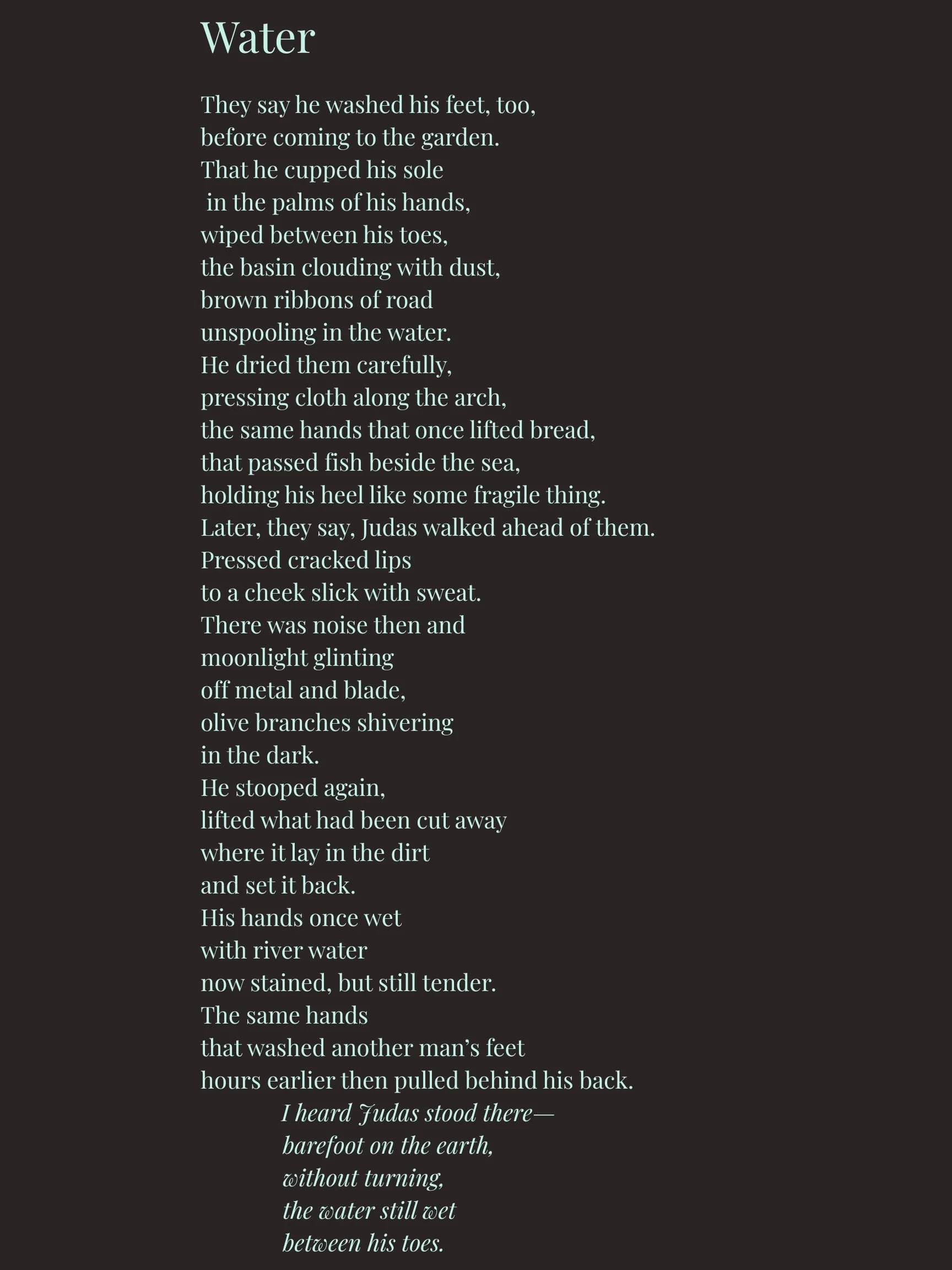
Artist: Mary Beth Ashley Davis
Artist Statement
This poem emerged from my fascination with the quiet, human moments inside the Passion narrative. I found myself lingering on the image of Jesus washing the disciples’ feet and realizing that Judas’s feet would have been washed as well. That small, almost easily overlooked detail became the emotional center of the poem. I began wondering what it might mean that Judas carried the water from that basin on his skin even as he walked into betrayal.
Writing the poem revealed to me how powerful restraint can be in telling a biblical story. Rather than retelling the entire narrative of Gethsemane, I wanted to focus on a single sensory thread: water. Water becomes dust-clouded in the basin, river water on Christ’s hands, and finally the lingering dampness between Judas’s toes. Through that image, the poem explores the unsettling tension between tenderness and violence, mercy and betrayal.
The challenge in writing this piece was finding language that honored the gravity of the story without becoming overly explanatory. I had to resist the impulse to interpret the moment for the reader and instead allow the images to carry the theological weight. By narrowing the focus to hands, water, and feet, I tried to let the poem inhabit the silence around Judas in that moment.
Ultimately, the poem revealed to me how proximity to grace does not necessarily prevent betrayal. Judas stands barefoot on the earth with the water of Christ’s care still on him. That image stayed with me long after writing the poem, and the piece became an attempt to sit with that uneasy truth rather than resolve it.